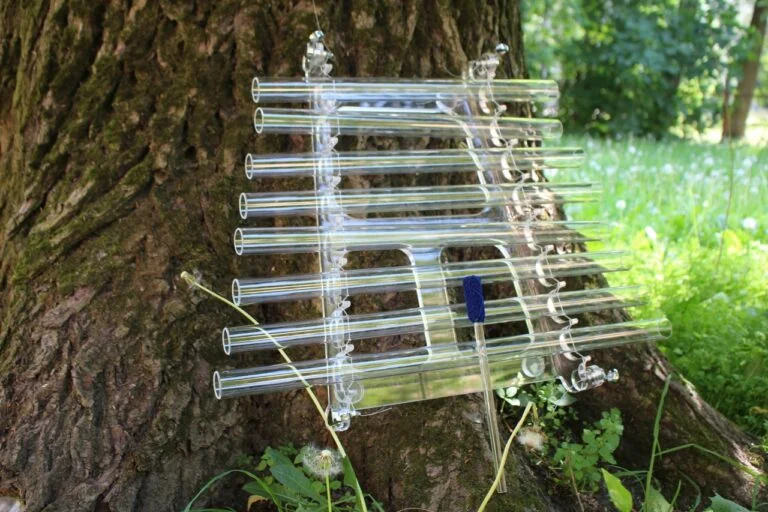
Discover the crystal harp and explore the Svaritanum workshop’s developments in quartz musical instruments.

The development of musical instruments has always depended on experimentation. Every important advancement — from keyboard mechanisms to modern percussion systems — has expanded the expressive possibilities available to musicians. At Svaritanum, we believe that quartz instruments deserve the same creative and engineering attention as traditional concert instruments. Our workshop combines musical experience, acoustic experimentation, industrial design, and precision engineering to develop new generations of crystal harps and crystalophones.
Our work goes beyond reproducing existing designs. We continuously explore new constructions, playing techniques, suspension systems, materials, and musical layouts. Several developments have become particularly important milestones in the history of our workshop.
1. The First Alchemical Crystal Harp
One of Svaritanum's distinctive innovations is the Alchemical Rainbow Crystal Harp, introduced by our workshop as the world's first crystal harp of its kind. Traditional crystal harps use transparent quartz-glass resonators. Our alchemical instruments take this concept further by incorporating specialized surface treatments containing metal compounds, including silver ions. These treatments give the resonators beautiful iridescent colors, transforming the instrument into a visually striking work of art. The additional surface layer also changes certain physical characteristics of the resonators and can influence their acoustic response.
The resulting sound has a distinctive character that complements the rich resonance of the quartz. The Alchemical Rainbow Crystal Harp brings together the precision of modern glass technology, the visual beauty of colored resonators, and the musical possibilities of quartz percussion. It has become one of the signature instruments of the Svaritanum collection.
2. The Curved Frame: A New Approach to Crystal Harp Design

The frame of a crystal harp is much more than a decorative element. It determines how the instrument is held, how the notes are positioned, and how comfortably the musician can reach each resonator. Svaritanum introduced curved frame designs as part of its exploration of crystal harp ergonomics and visual identity. The curved construction brings together functional engineering and sculptural aesthetics.
It allows the arrangement of the resonators to be considered in relation to the natural movements of the performer's hands, while giving the instrument its distinctive silhouette. The challenge is to combine a comfortable playing position with an acoustically suitable suspension structure and sufficient mechanical rigidity. For Svaritanum, the development of the frame reflects a central design principle: musical instruments should be both beautiful objects and practical tools for creative expression.
3. The First Crystalophone with a Sustain Pedal
One of the most significant milestones in Svaritanum's development was the creation of a chromatic crystalophone with a controllable sustain system. Introduced in 2017, the instrument represented an important step toward making quartz percussion suitable for advanced musical performance. Traditional crystal harps are characterized by their long sustain. While this is a major advantage for meditation and ambient music, it can become a limitation when performing fast melodies, complex harmonic progressions, or music that requires precise articulation.
Notes continue to resonate even after the performer has moved on to another musical phrase. The solution was to develop a mechanical damping system controlled by a pedal. Like the damper mechanism of a piano or the sustain control of a vibraphone, the system allows musicians to manage the duration of the notes. The performer can let the quartz resonators ring freely or reduce their sustain when greater rhythmic precision is required.
Svaritanum presented this design as the world's first chromatic crystalophone with variable sustain control. This innovation significantly expanded the instrument's musical possibilities. The crystalophone became capable of performing not only atmospheric improvisations but also more technically demanding repertoire, including classical compositions, contemporary music, and jazz-inspired arrangements. The development demonstrated that quartz instruments could evolve beyond their conventional role in sound meditation and become fully expressive concert instruments.
4. Crossed Notes: Innovative Chromatic Layout

Another important Svaritanum development is the patented crossed-note arrangement, also known as the X-shaped resonator layout. In conventional chromatic percussion instruments, notes are often arranged in two parallel rows, resembling the white and black keys of a piano. However, the physical dimensions of quartz tubes create special challenges when adapting this layout. A traditional configuration can make the instrument unnecessarily large or place certain resonators too far from the performer's hands.
Svaritanum developed an alternative arrangement in which groups of resonators are positioned at an angle to each other. The intersecting geometry allows the playing points to remain conveniently accessible while the tubes themselves occupy a more compact space. This solution combines several advantages:
- More efficient use of the instrument's overall dimensions.
- Convenient access to chromatic notes.
- Improved ergonomics for melodic and harmonic performance.
- Greater flexibility in the construction of multi-octave instruments.
- A distinctive design that combines musical functionality with engineering innovation.
The crossed-note system became an important feature of Svaritanum chromatic crystal harps and crystalophones. It demonstrates how rethinking the physical arrangement of resonators can open new possibilities for both instrument construction and performance.
5. Bringing Crystal Instruments to a Wider Audience
Innovation is not limited to mechanical inventions. An equally important part of Svaritanum's work is introducing quartz musical instruments to new audiences and new musical environments. From the beginning, our workshop has sought to demonstrate that the crystal harp is more than a specialized instrument for meditation. We have explored its possibilities in solo performances, ensemble music, improvisation, contemporary composition, and collaborations with musicians from different traditions.
Svaritanum instruments have been used in professional musical projects, including performances by the Mama Nature group and other artists. Our crystalophone has also been presented in a concert setting at the Great Hall of the Saint Petersburg Philharmonia, demonstrating the instrument's potential beyond the traditional sound-healing environment. Through instrument development, performances, educational materials, recordings, and international distribution, Svaritanum has helped bring the sound of quartz instruments to musicians and listeners around the world.
We continue to develop compact travel instruments, professional chromatic crystalophones, alchemical quartz resonators, and new approaches to musical tuning. Our goal is to make crystal instruments more expressive, accessible, versatile, and inspiring.