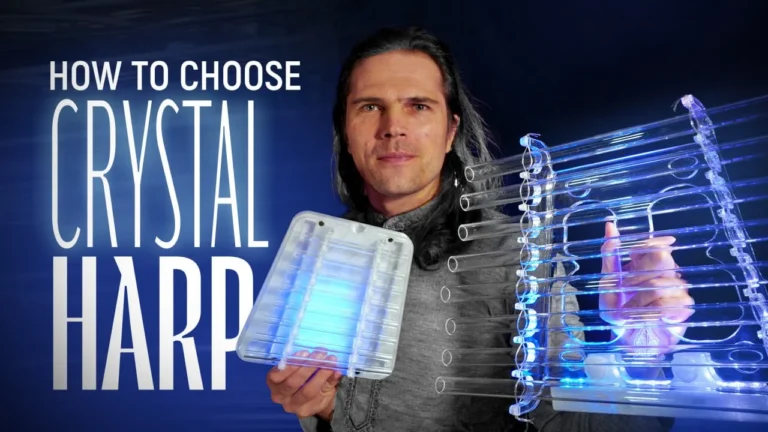
Discover the extraordinary sound of the crystal harp, how quartz instruments are made, and how Svaritanum is expanding the possibilities of crystal music.

The crystal harp is one of the most fascinating musical instruments of the modern era. Combining the ancient principles of percussion instruments with the remarkable acoustic properties of pure quartz glass, it produces a distinctive sound — clear, deep, resonant, and seemingly suspended in space. Its shimmering tones can resemble the singing of crystal bowls, the rich overtones of a gong, or the delicate resonance of bells. Yet the crystal harp possesses a unique musical character of its own.
Originally associated primarily with meditation and sound healing, the instrument has gradually evolved into a versatile means of musical expression, suitable for improvisation, composition, ensemble performance, and even complex concert repertoire. At Svaritanum, we see the crystal harp not only as a beautiful source of sound but also as an instrument whose musical and technological possibilities are still being discovered.
1. What Is a Crystal Harp?
A crystal harp, also known as a quartz harp, crystal xylophone, or in certain configurations a crystalophone, is a tuned percussion instrument belonging to the idiophone family. It consists of a series of carefully tuned hollow quartz-glass tubes mounted on a specially designed frame. Each tube produces a particular musical note when gently struck with a mallet or activated using other playing techniques.
Despite its name, the crystal harp is not a traditional stringed harp. Its sound is generated by the vibration of solid quartz-glass resonators rather than strings. From the perspective of musical instrument classification, the crystal harp shares certain principles with the xylophone, marimba, vibraphone, and traditional African balafon. Like these instruments, it allows musicians to create melodies, harmonies, and rhythmic patterns by playing individually tuned elements. However, the crystal harp differs significantly in both its construction and its acoustic behavior.
Unlike a wooden xylophone, whose notes typically have a relatively short and percussive sound, the quartz tubes of a crystal harp can sustain their vibrations for an extended period. A single gentle strike may produce a tone that continues to resonate long after the initial impact. When several notes are played together, their vibrations overlap, creating a rich harmonic atmosphere. Chords gradually merge into layers of sound, producing a beautiful sense of depth and spaciousness.
This combination of melodic clarity and long-lasting resonance makes the crystal harp especially suitable for ambient music, meditation, sound baths, and experimental composition.
A Modern Instrument with Ancient Roots
The fundamental concept behind the crystal harp is ancient: a collection of resonating objects, each tuned to a specific pitch. Human cultures have used wooden, stone, metal, and glass objects to create pitched percussion instruments for centuries. The contemporary crystal harp continues this tradition using modern materials, precise tuning methods, and innovative engineering.
Although musical glass has a long history, the modern quartz-tube crystal harp is a comparatively recent development, becoming increasingly visible during the twenty-first century alongside the growing popularity of crystal singing bowls and contemporary sound meditation practices. Today, crystal harps are used by musicians, composers, improvisers, sound practitioners, and artists seeking new timbres and expressive possibilities.
2. How Does a Crystal Harp Produce Sound?
The unique voice of a crystal harp results from the interaction of several physical factors: the mechanical properties of quartz glass, the geometry of each tube, the suspension system, and the manner in which the instrument is played.
The Vibration of Quartz Tubes
When a quartz tube is gently struck, the impact transfers mechanical energy into the glass. This causes the tube to flex and vibrate in several natural modes simultaneously. Each vibration mode contributes a particular frequency component to the resulting sound. Together, these components create the instrument's characteristic timbre. The lowest prominent vibration modes establish the perceived musical pitch, while higher-frequency partials add brightness, complexity, and a bell-like quality.
These partials are not necessarily exact integer multiples of the fundamental frequency. Their relationship is one of the reasons why the crystal harp sounds distinctly different from a flute, violin, or other instruments that produce more harmonically aligned frequency spectra. The tube itself acts as the primary vibrating body, radiating sound into the surrounding air. Its hollow geometry also influences the acoustic response. Because quartz glass can support sustained mechanical oscillations, a well-designed and properly suspended tube may produce a remarkably long and clear resonance.
Why Tube Dimensions Matter
Every note of a crystal harp is carefully adjusted to a desired musical pitch. The frequency and character of the sound depend on several parameters:
- Tube length: Longer tubes generally produce lower notes, while shorter tubes produce higher notes.
- Outer diameter: The diameter influences the tube's stiffness, vibration frequencies, and sound character.
- Wall thickness: Thickness affects the mechanical properties and modal frequencies of the resonator.
- Material characteristics: Density, elasticity, internal damping, and structural uniformity all influence acoustic behavior.
Larger quartz resonators can often produce a fuller, more spacious sound, with greater acoustic presence. This is why different crystal harp models may have noticeably different tonal qualities even when they are tuned to the same musical scale. At Svaritanum, we explore these relationships through instruments of different dimensions, from compact travel harps to large resonant concert models.
The Importance of the Suspension System
One of the most important — and often overlooked — elements of a crystal harp is the way its quartz tubes are supported. A resonator must be held securely while remaining as free as possible to vibrate. If a tube is clamped too tightly, or if its vibrations are transferred excessively into the supporting frame, part of its energy is lost. This may reduce sustain, alter the sound, or introduce unwanted mechanical noise.
For this reason, crystal harps use specialized suspension systems designed to minimize interference with the natural vibration of the quartz. In Svaritanum instruments, the tubes are supported by a carefully arranged flexible string suspension. The design allows the resonators to remain securely positioned while minimizing direct contact with rigid structural elements. The suspension also helps isolate neighboring notes, reducing unwanted mechanical interaction between the tubes. The result is a more open, sustained, and expressive sound.
A successful crystal harp is therefore not simply a collection of tuned glass tubes. It is a precisely engineered acoustic system in which every element contributes to the final musical result.
Playing Techniques and Sound Expression

The crystal harp offers a surprisingly wide range of playing techniques. The most common method is to strike the quartz tubes gently using special mallets. Different mallet materials and playing dynamics produce different tonal colors. Soft strikes can create warm, delicate tones, while more pronounced articulation adds brightness and clarity. Depending on the instrument and the technique, performers may also use their fingers or palms to activate or modify the sound.
Explore controlled sustain, resonator layouts and our workshop’s designs in Svaritanum: Innovation in Crystal Musical Instruments.
3. Quartz Glass: The Material Behind the Sound

At the heart of the crystal harp is an extraordinary material: high-purity quartz glass, also known as fused quartz or fused silica. Its principal chemical component is silicon dioxide, with the chemical formula SiO₂. Silicon dioxide occurs naturally in many forms, including quartz crystals, sand, and various minerals. However, an important distinction exists between natural crystalline quartz and the quartz glass used in musical instruments.
Crystal Quartz vs. Fused Quartz Glass
Natural quartz is a crystalline material. Its atoms are arranged in a highly ordered, repeating structure. Quartz glass, by contrast, is an amorphous solid. It has essentially the same chemical composition but lacks the long-range crystalline structure of natural quartz. This distinction is important. The resonators of a modern crystal harp are generally manufactured from fused quartz glass rather than cut directly from naturally occurring quartz crystals.
The familiar term crystal harp therefore refers to the instrument's material heritage and musical identity, although the finished tubes are technically glass. High-quality quartz glass may contain approximately 99.9% SiO₂ or more, depending on its grade and production method. This high chemical purity, together with the material's mechanical and thermal properties, makes it suitable for precision optical equipment, scientific applications, and specialized musical instruments.
What Makes Quartz Glass Special?
Quartz glass possesses an unusual combination of characteristics.
High stiffness and dimensional stability
Quartz glass is mechanically rigid, allowing shaped resonators to maintain their geometry and support well-defined vibration modes.
Low internal acoustic damping
Appropriate quartz-glass resonators can maintain vibrations for relatively long periods, contributing to the extended sustain associated with crystal instruments.
Excellent thermal stability
Quartz glass has an exceptionally low coefficient of thermal expansion compared with most ordinary glass materials. This means its dimensions change relatively little with temperature, helping provide stable physical characteristics.
High chemical purity
The material contains very few impurities compared with conventional glass formulations. Its purity is valuable in optical, scientific, and technological applications.
Optical transparency
High-quality fused silica can transmit light across a broad wavelength range. This gives transparent crystal harps their beautiful, almost weightless visual appearance.
Hardness combined with brittleness
Despite its strength and hardness, quartz glass is brittle. A tube may withstand normal musical vibrations but can fracture if dropped, struck against another hard object, or exposed to damaging mechanical stress. For this reason, designing, manufacturing, transporting, and performing with quartz instruments require particular care.
How Quartz Glass Tubes Are Made
The production of quartz-glass tubes is a technologically demanding process. Unlike ordinary glass, quartz glass requires extremely high temperatures for processing. Depending on the manufacturing method and grade, quartz glass is formed and worked at temperatures that can exceed 1,600–1,700°C. The starting material may be high-purity natural quartz or synthetic silica. During industrial manufacturing, the material is heated until it becomes sufficiently workable and can be formed into the required geometry.
Quartz tubing may be produced through specialized drawing and forming processes that maintain precise control over its diameter, wall thickness, and structural uniformity. Working with quartz glass requires equipment capable of generating extremely high temperatures, as well as specialized knowledge of the material's behavior. The resulting tubes must meet demanding requirements for quality and consistency. Small deviations in dimensions can significantly influence the musical pitch and the vibration characteristics of the finished resonator.
From a Quartz Tube to a Musical Note
Manufacturing the raw tube is only the beginning. Transforming quartz glass into a musical instrument requires further precision work. The instrument maker must select suitable tubing, determine the resonator dimensions, prepare the individual tubes, and carefully tune them to the desired frequencies. Every tube must be checked not only for its nominal pitch but also for the richness, stability, and balance of its sound. The aim is to achieve a coherent musical system in which neighboring notes respond naturally together.
Special attention is given to the interaction between resonator dimensions, sound quality, tuning accuracy, and suspension. This work combines acoustic engineering, material science, musical knowledge, and craftsmanship. In a well-made crystal harp, technical precision becomes almost invisible. What remains is the effortless impression of clear, floating sound.
For handling and maintenance, see Instructions for Using a Quartz Harp or Crystalophone.
4. The Musical Possibilities of the Crystal Harp
The appeal of the crystal harp extends far beyond its unusual sound. Its expressive character makes it suitable for a wide range of musical approaches.
Meditation and Sound Baths
The long, overlapping tones of quartz instruments are especially effective for creating slow, spacious musical textures. A single chord can continue evolving long after the notes have been played, allowing listeners to focus on subtle changes in resonance. For this reason, crystal harps are widely appreciated in meditation sessions, sound baths, yoga environments, and relaxation practices. Many listeners describe the sound as peaceful, immersive, or deeply calming. These experiences are subjective and do not require assuming that particular frequencies have scientifically established healing properties.
Ambient and Contemporary Music
In ambient music, the crystal harp provides an organic alternative to electronic pads and synthesizers. Its natural resonance can create evolving harmonic layers without electronic processing. When combined with electronic effects, looping, or other acoustic instruments, its sound can become part of complex contemporary arrangements.
Melodic Performance and Improvisation
Although crystal harps are often associated with slow music, their possibilities are not restricted to this style. Diatonic and chromatic arrangements allow musicians to explore melodies, chords, modal improvisation, and harmonic development. Advanced crystalophones with sustain control offer additional freedom for rhythmic and technically demanding passages.
Sound Design and Recording
The crystal harp is also a powerful tool for composers and sound designers. Its combination of sustained partials, shimmering attacks, and spatial resonance makes it valuable for film scores, experimental music, atmospheric soundtracks, and studio production.
5. Different Scales and Tuning Frequencies
A crystal harp can be designed for a particular musical scale or tuning system. Some instruments feature pentatonic scales, which allow intuitive improvisation and naturally compatible note combinations. Others use diatonic scales, providing broader harmonic possibilities. Chromatic crystal harps and crystalophones include the semitones needed for a much wider range of musical repertoire. At Svaritanum, we offer a variety of standard and customized arrangements. Our instruments can be tuned to different reference frequencies, including A4 = 440 Hz, 432 Hz, and 444 Hz.
440 Hz is the most widely used modern orchestral reference pitch. 432 Hz and 444 Hz are alternative tuning references that are popular among some musicians and sound-meditation practitioners. Each tuning produces a slightly different overall pitch level, and musicians may prefer one or another for artistic, aesthetic, or personal reasons. The choice of scale, register, tube dimensions, and tuning reference all contribute to the final musical personality of the instrument.
6. The Future of Crystal Musical Instruments
The history of musical instrument development shows that even familiar acoustic principles can lead to extraordinary new possibilities when combined with innovative engineering. Quartz glass offers a unique foundation for this exploration. Its transparency, mechanical characteristics, and distinctive resonance create opportunities that differ significantly from those of wood, metal, or conventional glass. The modern crystal harp is still a relatively young instrument, and its full expressive potential has yet to be explored.
New suspension systems, improved ergonomic designs, controlled sustain mechanisms, compact travel constructions, and innovative resonator arrangements are already transforming the way quartz instruments can be played. At Svaritanum, we are proud to participate in this evolution. We believe the future of crystal instruments lies in the combination of acoustic beauty, technical precision, and creative freedom. The crystal harp connects the timeless human fascination with resonant sound to the possibilities of modern craftsmanship and musical invention.
It is more than a collection of quartz tubes. It is a new voice in the world of music — a voice that continues to evolve.
Explore the Svaritanum collection of crystal harps, alchemical quartz instruments, and professional crystalophones. Discover new sounds, custom tunings, and innovative designs created for musicians, sound practitioners, and anyone inspired by the beauty of crystal resonance.