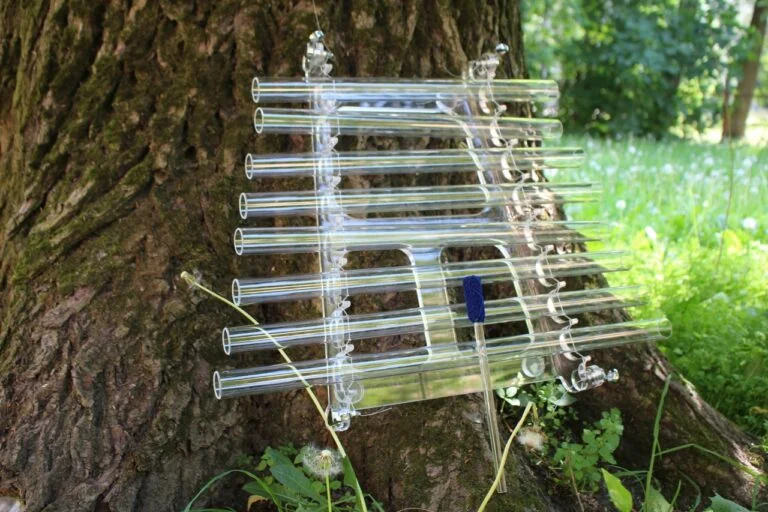
Explore musical frequencies, Earth’s natural resonance, sound healing traditions, and the fascinating connection between 444 Hz and the 528 Hz Love Frequency.
Choosing the right tuning for your Crystal Harp is an important part of shaping your musical experience.
While 440 Hz is the international standard for musical instruments, alternative tunings such as 432 Hz and 444 Hz have become increasingly popular among meditation musicians, sound healing practitioners, and people interested in the relationship between music, nature, and consciousness.
Each tuning offers a slightly different musical experience. Each also carries its own history, symbolism, and associations within contemporary sound healing traditions.
432 Hz is often called the Frequency of Nature or Earth’s Frequency, associated with grounding, harmony, and inner peace.
440 Hz is the standard reference pitch of modern music, offering versatility, compatibility, and a familiar musical foundation.
444 Hz is associated by some sound healing practitioners with positive transformation, spiritual alignment, and the celebrated 528 Hz Love Frequency.
But how much of this is supported by science? Where do these beliefs originate? And how can you choose the most suitable tuning for your Crystal Harp?
In this comprehensive guide, we explore each frequency from three perspectives:
- Musical acoustics: What these frequencies actually mean and how they affect musical notes.
- Scientific research: What studies have discovered about music, relaxation, and different tuning references.
- Sound healing traditions: The spiritual theories, historical associations, and symbolic interpretations surrounding these frequencies.
Our goal is to help you make an informed and intuitive choice, whether you are a professional musician, meditation practitioner, sound therapist, or simply someone inspired by the beauty of crystalline sound.
Table of Contents
- Understanding Musical Tuning Frequencies
- 440 Hz — The International Musical Standard
- 432 Hz — The Frequency of Nature and Harmony
- 432 Hz and the Earth’s Frequency: Schumann Resonance
- 432 Hz, Sacred Geometry, and Ancient Traditions
- 444 Hz — The Tuning Connected to 528 Hz
- 444 Hz Spiritual Meaning and Angel Numbers
- 528 Hz — The Love Frequency and Solfeggio Tradition
- Scientific Research on Healing Frequencies
- 432 Hz vs 440 Hz vs 444 Hz: Comparison Chart
- How to Choose the Best Tuning for Your Crystal Harp
- Frequently Asked Questions
- Final Thoughts
- Scientific References
Understanding Musical Tuning Frequencies
Before comparing 432 Hz, 440 Hz, and 444 Hz, it is important to understand what these numbers actually represent.
Hertz (Hz) is a unit of frequency that measures the number of oscillations per second.
For example, a pure tone with a frequency of 440 Hz completes 440 oscillation cycles every second.
In musical tuning, these numbers generally refer to the pitch of the note A4, also known as the A above middle C.
When an instrument is described as tuned to 432 Hz, this means that its reference note A4 has a frequency of 432 Hz.
Other musical notes are calculated according to this reference and the chosen tuning system.
This is an important distinction: a Crystal Harp tuned to 432 Hz does not produce only 432 Hz. It produces a collection of musical notes, each with its own specific frequency.
How Musical Tuning Changes the Entire Scale
In the modern 12-tone equal temperament system, adjusting the reference frequency changes the pitch of every note proportionally.
For example:
| Musical Note | A4 = 432 Hz | A4 = 440 Hz | A4 = 444 Hz |
|---|---|---|---|
| C4 | 256.87 Hz | 261.63 Hz | 264.01 Hz |
| D4 | 288.33 Hz | 293.66 Hz | 296.33 Hz |
| E4 | 323.63 Hz | 329.63 Hz | 332.63 Hz |
| F4 | 342.88 Hz | 349.23 Hz | 352.40 Hz |
| G4 | 384.87 Hz | 392.00 Hz | 395.56 Hz |
| A4 | 432.00 Hz | 440.00 Hz | 444.00 Hz |
| C5 | 513.74 Hz | 523.25 Hz | 528.01 Hz |
These values are calculated using 12-tone equal temperament. Other systems, including Pythagorean tuning and just intonation, produce different frequency relationships.
Notice the remarkable relationship in the last row:
When A4 is tuned to 444 Hz, C5 becomes approximately 528 Hz.
This mathematical connection plays an important role in the popularity of 444 Hz among musicians interested in Solfeggio frequencies.
However, musical tuning is only one element of an instrument’s sound.
The final listening experience also depends on its construction, musical scale, harmonic overtones, sustain, timbre, and playing technique.
440 Hz — The International Musical Standard
Scientific and Musical Facts
440 Hz is the internationally recognized standard reference pitch for modern musical instruments.
The standard is formally specified by ISO 16, which establishes A4 = 440 Hz as the standard musical pitch.
Before international standardization, musicians used a wide variety of tuning references.
Different cities, orchestras, instrument makers, and musical traditions often had their own preferred pitch levels.
Standardization helped establish consistency across instrument manufacturing, musical education, ensemble performance, and recording.
Today, 440 Hz is widely used in professional music production, electronic instruments, modern orchestras, and musical education.
Some orchestras use slightly higher references, such as 442 Hz or 443 Hz, but 440 Hz remains the most widely recognized standard.
Advantages of 440 Hz Tuning
The primary benefit of 440 Hz is musical compatibility.
A Crystal Harp tuned to A4 = 440 Hz can be played alongside most conventionally tuned instruments without requiring additional adjustments.
This makes it especially practical for musicians who perform with pianos, keyboards, flutes, guitars, synthesizers, and other melodic instruments.
440 Hz is also convenient for studio recording, live concerts, improvisation, and musical collaboration.
440 Hz in Sound Healing and Meditation
Although alternative tunings often receive more attention within sound healing communities, 440 Hz is equally capable of creating beautiful and deeply relaxing musical experiences.
The emotional effect of music depends on much more than the tuning reference.
Melody, harmony, rhythm, resonance, dynamics, and the listener’s individual perception all contribute to the experience.
Some sound healing practitioners appreciate 440 Hz as a balanced and familiar musical foundation.
Its versatility makes it suitable for combining Crystal Harps with singing bowls, synthesizers, ambient soundscapes, and other instruments.
There is no established scientific evidence that 440 Hz is inherently harmful or unsuitable for meditation.
Why Choose a 440 Hz Crystal Harp?
440 Hz is an excellent choice for musicians who value flexibility and conventional musical compatibility.
It is especially suitable for:
- Live performances with other musicians
- Studio recording and music production
- Improvisation with conventional instruments
- Professional musical arrangements
- Meditation music involving multiple instruments
Choose 440 Hz if you want the most versatile tuning for professional performance and collaboration.
432 Hz — The Frequency of Nature and Harmony
Scientific and Musical Facts
432 Hz is an alternative reference pitch in which A4 vibrates at 432 cycles per second.
Compared with the 440 Hz standard, the entire musical scale is approximately 1.8% lower in frequency.
This corresponds to approximately 31.8 cents, or about one-third of a semitone.
When comparing identical melodies played in 432 Hz and 440 Hz, the lower tuning can be perceived as slightly deeper.
Some listeners describe 432 Hz music as softer, warmer, or more peaceful.
These descriptions are subjective, however. Changing the tuning reference does not automatically change the harmonic structure of a composition.
The Historical Background of 432 Hz
Throughout musical history, there has never been a single universally accepted pitch reference.
Different European musical traditions used varying tuning standards.
One historical example is the French diapason normal, established in the nineteenth century at A4 = 435 Hz.
The Italian composer Giuseppe Verdi also expressed support for lower orchestral tuning, and his name is frequently associated with 432 Hz.
This historical connection is one reason 432 Hz is sometimes called Verdi’s Tuning.
However, modern claims that all ancient civilizations used 432 Hz as a universal tuning are not supported by reliable historical evidence.
The contemporary popularity of 432 Hz is mainly associated with meditation music, alternative tuning systems, and sound healing traditions.
432 Hz in Sound Healing
Within contemporary sound healing communities, 432 Hz is often described as a frequency of natural harmony, grounding, and inner balance.
Many practitioners believe that music tuned to this reference supports a sense of connection with nature.
It is frequently associated with peaceful contemplation, emotional balance, and meditative awareness.
Common spiritual associations include:
- Deep relaxation and inner peace
- Grounding and connection with nature
- Emotional harmony
- Mindfulness and meditative awareness
- A sense of natural balance
- Gentle and contemplative musical expression
These associations reflect sound healing traditions and subjective experiences rather than established biological properties of 432 Hz.
Nevertheless, many musicians genuinely prefer the musical character of this slightly lower tuning.
Scientific Studies of 432 Hz
A small pilot study published in 2019 compared responses to music tuned to 432 Hz and 440 Hz.
The researchers observed a greater reduction in average heart rate during 432 Hz listening sessions.
Another randomized clinical study published in 2020 investigated the effects of 432 Hz and 440 Hz music during dental procedures.
Both tunings were associated with reduced anxiety compared with no music, while the 432 Hz group showed lower salivary cortisol levels.
These early findings have encouraged further interest in alternative musical tuning.
However, the studies were relatively small, and their results do not establish that 432 Hz has universally superior therapeutic properties.
Why Choose a 432 Hz Crystal Harp?
A Crystal Harp tuned to 432 Hz offers a slightly lower musical reference and a strong connection with contemporary meditation traditions.
It is especially appealing for:
- Meditation and mindfulness sessions
- Sound baths
- Yoga and relaxation practices
- Contemplative improvisation
- Ambient and spiritual music
- Personal sound exploration
Choose 432 Hz if you enjoy a slightly lower pitch and feel connected to its symbolism of harmony, grounding, and nature.
432 Hz and the Earth’s Frequency: Schumann Resonance
One of the most fascinating beliefs surrounding 432 Hz is its supposed connection with the natural vibrations of our planet.
This has led to its popular names:
Earth’s Frequency, Nature’s Frequency, and the Frequency of Universal Harmony.
The theory is frequently connected with a real scientific phenomenon known as the Schumann resonance.
What Is the Schumann Resonance?
Schumann resonances are naturally occurring electromagnetic resonances in the space between the Earth’s surface and the ionosphere.
They are primarily excited by global lightning activity.
The fundamental resonance occurs at approximately 7.83 Hz, although its frequency and characteristics vary with environmental conditions.
This natural phenomenon is sometimes poetically called “The Heartbeat of the Earth.”
Unlike ordinary musical sound, Schumann resonances are electromagnetic phenomena rather than acoustic vibrations traveling through the air.
Their existence is scientifically established and measurable.
How Is 432 Hz Connected to Earth’s Resonance?
Some sound healing theories connect the Schumann resonance to musical tuning by rounding its fundamental frequency from approximately 7.83 Hz to 8 Hz.
Repeated octave doubling then produces:
8 → 16 → 32 → 64 → 128 → 256 Hz
The resulting frequency of 256 Hz has a historical association with a tuning reference sometimes called Scientific Pitch or Philosophical Pitch, where middle C is assigned exactly 256 Hz.
In a Pythagorean tuning system, A4 can be derived from C4 = 256 Hz using the interval ratio 27:16.
256 × 27/16 = 432 Hz
This produces a mathematically coherent connection between an idealized 8 Hz starting point, C = 256 Hz, and A = 432 Hz.
For proponents of this theory, the relationship represents a beautiful symbolic connection between music and the natural world.
However, the actual fundamental Schumann resonance is closer to 7.83 Hz, not exactly 8 Hz, and no established physical mechanism demonstrates that A4 = 432 Hz has a uniquely beneficial relationship with Earth’s electromagnetic resonance.
The mathematics is valid under the stated assumptions; the proposed special connection to the Earth remains an interpretation.
Why the Earth’s Frequency Theory Is So Appealing
The idea that music can reflect the natural rhythms of our planet has a powerful poetic appeal.
For many meditation practitioners, it represents a symbolic connection between the human experience of sound and the larger natural environment.
The belief also fits into a broader philosophy in which harmony is understood as a relationship between mathematics, nature, and consciousness.
For musicians inspired by this perspective, 432 Hz can serve as a meaningful artistic choice.
432 Hz, Sacred Geometry, and Ancient Traditions
Beyond the Schumann resonance, 432 Hz has acquired numerous symbolic associations with sacred geometry, spiritual numerology, and ancient traditions.
432 Hz and Sacred Numbers
Supporters of sacred geometry often point to numerical relationships involving 108, 216, and 432.
For example:
108 × 4 = 432
The number 108 has special significance in several Eastern spiritual traditions.
It appears in meditation practices, prayer bead traditions, and various systems of spiritual symbolism.
The number 432 also appears in traditional cosmological calculations, including certain Hindu concepts of cyclical time.
For some sound healing practitioners, these numerical patterns suggest a symbolic connection between music, sacred mathematics, and universal harmony.
The numerical relationships themselves are valid, but their proposed spiritual or physiological significance remains a matter of interpretation.
Was 432 Hz Used in Ancient Civilizations?
A popular belief suggests that ancient Egyptians, Greeks, and other civilizations used 432 Hz in sacred music.
Some contemporary theories also connect it with ancient temples, ceremonial instruments, and the philosophy of Pythagoras.
Pythagorean musical theory certainly explored the relationship between numerical ratios and harmonious intervals.
However, ancient musical systems did not necessarily use the modern concept of a universal fixed A4 reference.
There is no reliable historical evidence that all ancient civilizations tuned their instruments to A4 = 432 Hz.
Still, these stories reflect a genuine historical fascination with the relationship between music, mathematics, and the cosmos.
432 Hz as a Symbol of Natural Harmony
In modern sound healing practice, 432 Hz has become a symbol of returning to nature and seeking inner balance.
Some practitioners associate it with:
- The rhythms of the natural world
- Sacred mathematical proportions
- The Earth’s symbolic heartbeat
- Ancient musical wisdom
- Spiritual grounding
- Harmony between humanity and nature
Whether understood literally or symbolically, these associations continue to inspire contemporary meditation music.
444 Hz — The Tuning Connected to 528 Hz
Scientific and Musical Facts
444 Hz is an alternative musical tuning reference in which A4 vibrates at 444 cycles per second.
It is approximately 0.9% higher than the 440 Hz international standard.
This corresponds to about 15.7 cents, a relatively subtle musical difference.
When compared directly with 440 Hz, music tuned to 444 Hz sounds slightly higher in pitch.
However, the most interesting feature of 444 Hz is its mathematical relationship with the celebrated 528 Hz Solfeggio frequency.
The Mathematical Connection Between 444 Hz and 528 Hz
In 12-tone equal temperament, the note C5 is three semitones above A4.
The frequency of C5 can be calculated using the formula:
C5 = A4 × 2^(3/12)
If A4 is tuned to 444 Hz:
C5 = 444 × 2^(3/12) ≈ 528.01 Hz
Therefore:
A4 = 444 Hz → C5 ≈ 528 Hz
This is a mathematically verifiable relationship.
It is also one of the main reasons 444 Hz tuning has become particularly interesting to musicians exploring modern Solfeggio frequencies.
| Reference Tuning | C5 Frequency |
|---|---|
| A4 = 432 Hz | 513.74 Hz |
| A4 = 440 Hz | 523.25 Hz |
| A4 = 444 Hz | 528.01 Hz |
Unlike spiritual interpretations of specific frequencies, this mathematical relationship can be calculated and verified.
Does Every 444 Hz Crystal Harp Produce 528 Hz?
Not necessarily.
A Crystal Harp tuned to A4 = 444 Hz follows this reference, but the notes it actually produces depend on its musical scale, register, and temperament.
For example, a Crystal Harp covering the range F5–F6 may include C6 rather than C5.
In equal temperament:
C5 ≈ 528 Hz
C6 ≈ 1056 Hz
C6 is one octave above C5.
Because octave-related frequencies share a 2:1 relationship, they are perceived as corresponding notes in different registers.
This creates an interesting musical connection to 528 Hz even when the instrument plays in a higher octave.
However, 1056 Hz is not itself 528 Hz.
It is also important to consider the temperament: in Pythagorean tuning or other alternative tuning systems, the exact frequency of C may differ.
444 Hz in Sound Healing
Within contemporary sound healing traditions, 444 Hz is often associated with positive energy, spiritual transformation, and emotional openness.
Some practitioners describe it as a tuning connected with uplifting meditation, clarity, creativity, and inner alignment.
Its symbolic connection with the number 444 and mathematical connection with 528 Hz both contribute to its popularity.
Common associations include:
- Positive transformation
- Creativity and inspiration
- Emotional openness
- Heart-centered meditation
- Spiritual alignment
- Clarity and intention
- A sense of uplifting energy
These are contemporary spiritual interpretations rather than established physiological effects of 444 Hz.
Why Choose a 444 Hz Crystal Harp?
444 Hz offers a compelling combination of musical acoustics and spiritual symbolism.
It can be especially appealing for:
- Solfeggio-inspired compositions
- Heart-centered meditation
- Sound bath performances
- Ambient and spiritual music
- Creative improvisation
- Exploration of octave-related 528 Hz tones
Choose 444 Hz if you are inspired by the symbolism of 528 Hz, enjoy a slightly higher tuning, or wish to explore contemporary Solfeggio-inspired music.
444 Hz Spiritual Meaning and Angel Numbers
While 432 Hz is commonly associated with Earth’s natural harmony, 444 Hz has acquired a different symbolic meaning within contemporary spirituality.
One of the most popular associations is the concept of Angel Number 444.
What Does Angel Number 444 Mean?
In modern spiritual numerology, repeated numbers such as 111, 222, 333, and 444 are often called Angel Numbers.
These numerical patterns are interpreted by some people as symbols of spiritual guidance, personal growth, and meaningful synchronicity.
The number 444 is commonly associated with:
- Protection and spiritual support
- Stability and inner strength
- Harmony and balance
- Confidence and personal growth
- Trust in one’s chosen path
- Positive transformation
- Alignment with personal intentions
Some spiritual traditions interpret the repeated appearance of 444 as a reminder to remain grounded, trust the process of life, and continue moving toward meaningful goals.
These interpretations are part of modern numerological belief systems.
How Did Angel Number 444 Become Associated With Musical Tuning?
Some contemporary sound healing practitioners extend the symbolism of Angel Number 444 to music tuned to A4 = 444 Hz.
They interpret this tuning as a musical representation of spiritual guidance, protection, and positive transformation.
In this context, listening to or performing music at 444 Hz may become part of a personal meditation ritual.
For example, practitioners may combine the music with intention-setting, affirmations, visualization, or contemplative listening.
There is no scientific evidence that the numerical symbolism of 444 causes a unique physiological response to sound.
However, symbolic associations can play a meaningful role in how individuals approach meditation and artistic expression.
444 Hz and Spiritual Awakening
Within some contemporary spiritual communities, 444 Hz is described as a frequency of awakening, clarity, and emotional transformation.
Musicians drawn to this interpretation may use the tuning to create an atmosphere associated with inspiration, optimism, and self-reflection.
The slightly higher musical reference can also contribute to a subjective impression of brightness when directly compared with lower tunings.
These experiences vary from person to person.
444 Hz and the Heart Chakra
Some practitioners connect 444 Hz with heart-centered meditation because of its relationship with 528 Hz.
Within modern Solfeggio-based sound healing systems, 528 Hz is commonly associated with love, compassion, and emotional transformation.
Because A4 = 444 Hz places C5 close to 528 Hz in equal temperament, the tuning has become attractive to musicians exploring these themes.
The chakra associations belong to spiritual healing traditions rather than measurable acoustic or anatomical properties.
Still, they can offer a meaningful framework for personal meditation and creative music-making.
528 Hz — The Love Frequency and Solfeggio Tradition
528 Hz has become one of the most recognized frequencies in contemporary sound healing.
It is commonly known as:
The Love Frequency, The Miracle Tone, and The Transformation Frequency.
What Is 528 Hz?
From a scientific perspective, 528 Hz is a frequency corresponding to 528 oscillations per second.
Within an equal-tempered musical scale referenced to A4 = 444 Hz, it falls almost exactly on C5.
From a spiritual perspective, 528 Hz is commonly associated with love, compassion, emotional renewal, and transformation.
These associations have contributed to its popularity in meditation music, sound baths, and modern sound therapy.
The Solfeggio Frequencies
The modern Solfeggio frequency system commonly includes six principal frequencies:
| Frequency | Traditional Modern Association |
|---|---|
| 396 Hz | Liberation from fear and guilt |
| 417 Hz | Change and transformation |
| 528 Hz | Love, harmony, and positive transformation |
| 639 Hz | Relationships and connection |
| 741 Hz | Expression and clarity |
| 852 Hz | Intuition and spiritual awareness |
Extended versions of the system may also include 174, 285, and 963 Hz.
These associations belong to contemporary sound healing traditions and should not be confused with established medical effects.
Although the term Solfeggio has historical roots in musical education, the modern system of fixed numerical healing frequencies is a much more recent development.
Why Is 528 Hz Called the Love Frequency?
Within contemporary sound healing philosophy, 528 Hz is often associated with the heart, compassion, and unconditional love.
Some practitioners use it during meditation practices focused on emotional openness, gratitude, forgiveness, and personal transformation.
It is sometimes described as a frequency that supports harmony between the mind, body, and spirit.
Other theories attribute cellular restoration or DNA repair properties to 528 Hz.
These claims are widely discussed in alternative sound healing communities, but direct DNA repair through listening to 528 Hz has not been demonstrated by reliable clinical research.
Scientific Research on 528 Hz
Scientific interest in the effects of 528 Hz music has increased in recent years.
A small study published in 2018 investigated responses to music incorporating 528 Hz.
Researchers reported changes in selected stress-related measurements, including salivary cortisol, following listening sessions.
A randomized controlled study published in 2026 also explored physiological responses to music associated with 432 Hz and 528 Hz in university students.
The study reported differences in certain salivary biomarkers, including BDNF and CREB measurements, but did not establish corresponding immediate improvements in cognitive test performance.
These results are interesting preliminary findings.
They suggest that the relationship between musical listening, frequency, and physiological responses deserves further exploration.
However, larger, independently replicated studies are necessary before specific therapeutic conclusions can be drawn.
Why 528 Hz Is Especially Interesting for Crystal Harps
Crystal Harps produce clear, sustained musical tones with distinctive acoustic resonance.
Their long sustain allows individual notes and harmonic relationships to remain audible for extended periods.
This makes them particularly interesting for meditative music based on carefully selected scales and frequencies.
For musicians working with the modern Solfeggio tradition, the relationship between 444 Hz tuning and approximately 528 Hz C5 offers a practical foundation for musical composition.
It allows the celebrated frequency to be incorporated into a conventional musical scale, rather than treated only as an isolated tone.
Scientific Research on Healing Frequencies
Music has a measurable influence on human perception, emotion, and physiology.
Scientific studies have explored its relationship with stress, mood, attention, relaxation, breathing patterns, and autonomic nervous system activity.
Music listening can affect heart rate, emotional responses, and subjective well-being.
However, it is important to distinguish between the general effects of music and claims about individual tuning frequencies.
Can Music Influence the Body and Mind?
Yes.
A substantial body of scientific research indicates that music can influence emotional states, perceived stress, and certain physiological measurements.
These effects are influenced by numerous factors, including musical structure, tempo, loudness, timbre, familiarity, personal preference, and listening context.
Does One Specific Frequency Have Unique Healing Properties?
This is still an open scientific question.
Several small studies have compared music tuned to 432 Hz and 440 Hz.
Other studies have explored possible effects of music incorporating 528 Hz.
Some have reported interesting differences in physiological or psychological measurements.
However, the existing research does not yet establish any of these frequencies as universally superior for therapeutic purposes.
Research specifically isolating the effects of A4 = 444 Hz tuning is also limited.
The Difference Between Scientific Facts and Spiritual Interpretations
Both scientific exploration and spiritual traditions can contribute to how people experience music, but they answer different kinds of questions.
Science can measure vibration frequencies, acoustic relationships, physiological responses, and experimental outcomes.
Spiritual traditions may use frequencies as symbols of harmony, transformation, connection, and personal intention.
For example:
- The existence of Schumann resonances is a scientific fact.
- Their proposed special relationship with 432 Hz musical tuning is an interpretation.
- The relationship between A4 = 444 Hz and C5 ≈ 528 Hz is a mathematical fact in equal temperament.
- The association of 528 Hz with love and transformation is part of contemporary sound healing philosophy.
- The physiological effects of listening to music are a legitimate subject of scientific research.
- The idea that a particular reference pitch produces universal healing remains unproven.
These distinctions allow musicians and listeners to explore sound healing traditions while maintaining an informed understanding of acoustic science.
The Personal Experience of Sound
Music is more than a collection of numerical frequencies.
The emotional experience of a musical instrument also depends on resonance, timbre, harmony, memory, cultural associations, and individual perception.
A tuning that feels deeply peaceful to one person may create a different experience for someone else.
This is one reason why choosing a Crystal Harp can be both a technical decision and a personal artistic journey.
432 Hz vs 440 Hz vs 444 Hz: Comparison Chart
| Characteristic | 432 Hz | 440 Hz | 444 Hz |
|---|---|---|---|
| Reference note | A4 = 432 Hz | A4 = 440 Hz | A4 = 444 Hz |
| Pitch compared with standard | Lower | Standard | Higher |
| C5 in equal temperament | 513.74 Hz | 523.25 Hz | 528.01 Hz |
| Musical compatibility | Alternative tuning | Widest compatibility | Alternative tuning |
| Main symbolic association | Nature and harmony | Musical balance | Transformation and 528 Hz |
| Earth frequency association | Common in sound healing | Not commonly associated | Not commonly associated |
| Angel number symbolism | Sometimes associated with sacred numbers | Not commonly associated | Angel Number 444 |
| Solfeggio connection | Symbolic or scale-dependent | Scale-dependent | C5 ≈ 528 Hz |
| Meditation use | Popular | Suitable | Popular |
| Typical applications | Sound baths, ambient music, meditation | Concerts, ensembles, recording | Solfeggio-inspired music, meditation |
| Main practical advantage | Slightly lower pitch | Maximum compatibility | Mathematical 528 Hz connection |
Symbolic associations reflect contemporary spiritual and sound healing traditions, not established universal physiological effects.
Three Different Musical Philosophies
432 Hz — Connection With Nature
A tuning often associated with grounding, natural harmony, sacred mathematical proportions, and the symbolic heartbeat of the Earth.
440 Hz — Connection With the Musical World
The familiar international reference that offers flexibility, compatibility, and an established musical foundation.
444 Hz — Connection With Transformation
A tuning associated with spiritual symbolism, uplifting intentions, and an especially interesting mathematical relationship with the 528 Hz Love Frequency.
Each offers a different approach to musical expression.
How to Choose the Best Tuning for Your Crystal Harp
Selecting the right Crystal Harp tuning depends on your musical goals, existing instruments, preferred sound, and personal connection with the symbolism surrounding different frequencies.
At Svaritanum, we believe that musical instruments should inspire creativity, exploration, and meaningful experiences with sound.
Choose 432 Hz for Meditation and Natural Harmony
If you are primarily interested in meditation, contemplative music, or sound bath experiences, 432 Hz may be especially appealing.
Its slightly lower tuning and associations with natural harmony have made it popular among many sound healing practitioners.
You may feel drawn to 432 Hz if you appreciate its symbolism of grounding, nature, and peaceful awareness.
It is a beautiful option for solo meditative performances and personal sound exploration.
Choose 440 Hz for Musical Versatility
If you frequently perform with other musicians, use conventional instruments, or produce music in a studio, 440 Hz is usually the most practical choice.
It allows your Crystal Harp to integrate easily into existing musical arrangements.
440 Hz is particularly suitable for professional performances, collaborations, and recording projects.
Choose 444 Hz for the 528 Hz Connection
If you are interested in Solfeggio frequencies, the symbolism of Angel Number 444, or the spiritual associations of the Love Frequency, 444 Hz offers an interesting musical foundation.
In equal temperament, its C5 note falls almost exactly at 528 Hz.
For Crystal Harps using higher musical registers, octave-related frequencies may provide a corresponding musical relationship.
This tuning is particularly attractive for contemporary sound healing compositions and heart-centered meditation music.
Consider Your Existing Musical Instruments
If you already own singing bowls, flutes, chimes, keyboards, or other melodic instruments, consider their tuning before choosing your Crystal Harp.
Different reference pitches can produce audible tuning discrepancies when instruments are played together.
For conventional harmonic collaboration, matching tuning references is generally the easiest solution.
However, alternative tuning combinations can also become part of a creative musical experiment.
The Musical Scale Matters Too
The reference tuning is only one part of a Crystal Harp’s musical character.
Its scale determines which notes are available and how they interact.
For example, a major scale can create bright and open harmonic possibilities, while a pentatonic scale can make intuitive improvisation especially accessible.
The instrument’s register is also important.
Higher notes create a different musical atmosphere than lower notes, regardless of the reference tuning.
Temperament and Harmonic Relationships
Another important factor is the temperament used to tune the instrument.
Equal temperament is widely used in modern music because it provides a practical system for playing in different keys.
Pythagorean tuning, by contrast, is based on relationships derived from pure perfect fifths.
It produces different interval proportions and can be particularly interesting for instruments designed around a specific musical scale.
For Crystal Harps, the combination of reference pitch, musical scale, temperament, and register determines the actual fundamental frequencies of the notes.
This is especially relevant when choosing an instrument for music involving specific frequency values.
Listen to the Sound
Ultimately, your own listening experience is one of the most important factors.
If possible, compare recordings of the same melody played with different tuning references.
Notice which version feels most suitable for your musical intentions.
You may find yourself drawn to the lower pitch of 432 Hz, the familiar balance of 440 Hz, or the slightly higher tuning of 444 Hz.
There is no universally correct choice.
Frequently Asked Questions
Is 432 Hz really the frequency of the Earth?
432 Hz is often called Earth’s Frequency within contemporary sound healing traditions.
This belief is partly connected with the Schumann resonance, a real electromagnetic phenomenon with a fundamental frequency of approximately 7.83 Hz.
Some interpretations round this to 8 Hz and use octave relationships and historical tuning ratios to derive 432 Hz.
However, the idea that 432 Hz is the actual fundamental frequency of the Earth is not scientifically established.
Is 432 Hz better than 440 Hz for meditation?
Some listeners prefer 432 Hz because of its slightly lower pitch and its associations with relaxation and natural harmony.
A few small studies have reported differences in physiological responses, but there is not enough evidence to conclude that 432 Hz is universally more effective than 440 Hz.
Both tunings can create beautiful meditative music.
What is the spiritual meaning of 444 Hz?
In contemporary spiritual traditions, 444 Hz is often associated with protection, harmony, positive transformation, and personal alignment.
These associations are partly inspired by Angel Number 444 and its symbolism in modern numerology.
They are spiritual interpretations rather than established physiological effects of the frequency.
What is the connection between 444 Hz and 528 Hz?
In 12-tone equal temperament, when A4 is tuned to 444 Hz, the note C5 has a frequency of approximately 528.01 Hz.
This is a mathematical relationship based on the musical interval between A4 and C5.
It is one reason 444 Hz is popular among musicians exploring Solfeggio-inspired music.
Does a 444 Hz Crystal Harp contain the 528 Hz Love Frequency?
A 444 Hz equal-tempered instrument produces approximately 528 Hz if its range includes C5.
If it instead includes C6, that note is approximately 1056 Hz, one octave above 528 Hz.
The exact frequencies depend on the instrument’s range and temperament.
Why is 528 Hz called the Love Frequency?
Within contemporary Solfeggio sound healing traditions, 528 Hz is associated with love, compassion, emotional transformation, and harmony.
These symbolic interpretations have made it popular in meditation music.
Can 528 Hz repair DNA?
Some contemporary sound healing theories associate 528 Hz with cellular restoration and DNA repair.
However, there is currently no reliable clinical evidence demonstrating that listening to 528 Hz directly repairs human DNA.
Research into physiological responses to music continues, but such claims remain unproven.
What is the relationship between 432 Hz and sacred geometry?
Some spiritual interpretations connect 432 with numbers such as 108 and 216, which appear in traditional cosmology and numerical symbolism.
These relationships inspire theories about music, natural harmony, and universal mathematical patterns.
Their spiritual significance is a matter of interpretation rather than an established physical property.
Is 440 Hz harmful?
No reliable scientific evidence demonstrates that 440 Hz musical tuning is inherently harmful.
440 Hz is a widely used international reference pitch and can be used for meditation, relaxation, and sound healing music.
Can I play a 432 Hz Crystal Harp with 440 Hz instruments?
Yes, but instruments using different reference pitches will not align exactly in conventional musical intervals.
For ensemble performance, it is usually preferable to use matching tuning references or retune compatible instruments.
Which Crystal Harp tuning is best for sound healing?
There is no scientifically established single best tuning.
432 Hz is popular among practitioners who value grounding and natural harmony.
444 Hz is attractive to those interested in Solfeggio-inspired music and the symbolism of 528 Hz.
440 Hz offers the greatest compatibility with conventional instruments.
Your choice should reflect your musical goals, personal preferences, and the instruments you plan to combine.
Final Thoughts
432 Hz, 440 Hz, and 444 Hz represent three different approaches to musical tuning, each with its own practical advantages, history, and cultural associations.
440 Hz connects the Crystal Harp with the wider world of contemporary music, providing reliable compatibility and flexibility.
432 Hz offers a slightly lower musical reference and a rich collection of associations with natural harmony, sacred mathematics, and the symbolic heartbeat of the Earth.
444 Hz provides a fascinating musical connection with the celebrated 528 Hz Love Frequency, alongside contemporary spiritual associations with positive transformation and Angel Number 444.
Science helps us understand vibration, musical intervals, acoustic resonance, and the measurable effects of sound.
Sound healing traditions offer additional symbolic and experiential perspectives that can inspire meditation, creativity, and personal reflection.
These approaches do not need to compete. They can coexist as different ways of exploring the extraordinary relationship between music and human experience.
At Svaritanum, we create Crystal Harps for musicians, meditation practitioners, sound explorers, and everyone inspired by the beauty of pure crystalline resonance.
Whether you choose 432 Hz, 440 Hz, or 444 Hz, the most important element is the connection you develop with your instrument.
Explore Svaritanum Crystal Harps and discover the tuning that resonates with your music, your intentions, and your creative journey.
Scientific References
The following sources provide additional information about musical tuning standards and research into the physiological effects of music.
1. International Organization for Standardization
ISO 16:1975 — Acoustics: Standard Tuning Frequency.
https://www.iso.org/standard/3601.html
2. Calamassi, D., & Pomponi, G. P. (2019)
Music Tuned to 440 Hz Versus 432 Hz and the Health Effects: A Double-blind Cross-over Pilot Study.
Explore, 15(4), 283–290.
https://pubmed.ncbi.nlm.nih.gov/31031095/
3. Dental Anxiety and Music Tuning Research (2020)
Effect of Music at 432 Hz and 440 Hz on Dental Anxiety and Salivary Cortisol Levels in Patients Undergoing Tooth Extraction: A Randomized Clinical Trial.
Journal of Applied Oral Science.
https://pubmed.ncbi.nlm.nih.gov/32401941/
4. Akimoto, K., Hu, A., Yamaguchi, T., & Kobayashi, H. (2018)
Effect of 528 Hz Music on the Endocrine System and Autonomic Nervous System.
Health, 10, 1159–1170.
https://doi.org/10.4236/health.2018.109088
5. Randomized Controlled Trial (2026)
Acute Music-Frequency Exposure Modulates Salivary Stress and Neurotrophic Markers in Young Adults: A Randomized Controlled Trial.
https://pubmed.ncbi.nlm.nih.gov/42043979/
Editorial note: This article combines established acoustic science, preliminary scientific research, historical context, and descriptions of contemporary sound healing beliefs. Spiritual interpretations are presented as traditions and personal perspectives, not as scientifically verified medical claims. Musical instruments and sound healing practices are not substitutes for medical treatment.