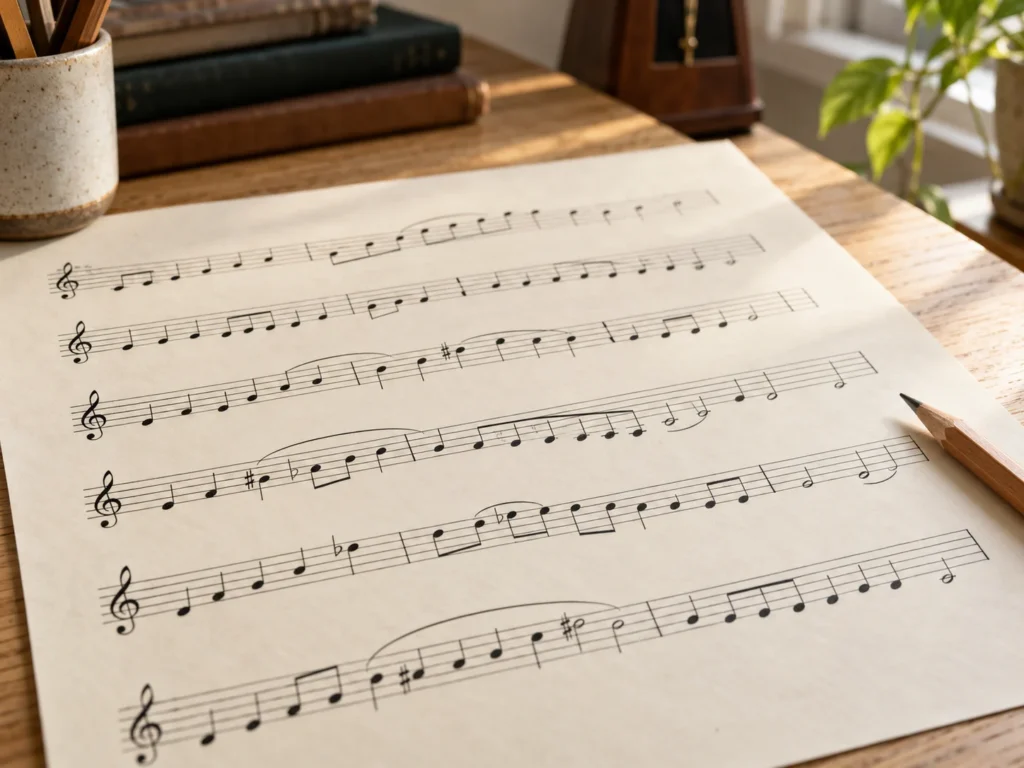
A scale gives your instrument a musical vocabulary. Some patterns feel familiar and settled; others invite spacious improvisation, quiet reflection or a little more tension. This guide explores the thirteen scales and modes in our list, with a little background, a listening impression and a simple example for each.
You do not need to read music to choose. Begin with the character that attracts you, then listen to demonstrations. Words such as bright, grounded and mysterious are listening suggestions: tempo, register, touch and your own experience can change how a scale feels.
Explore the 13 scales and modes
How to read the examples
The root note is the musical home of a scale. The numbers describe its steps relative to the major scale on that root: ♭ means one semitone lower and ♯ means one semitone higher. Every example below begins on C so you can compare the patterns; the final C marks the next octave. These examples are not a specification of any particular instrument’s range. A pentatonic instrument may repeat its five pitch classes across six, nine or more sounding notes.
Scale and reference pitch are separate choices. A4 = 432, 440 or 444 Hz changes the reference tuning, while the scale describes relationships between notes. Read our guide to choosing your instrument pitch if you would like help with that choice. Available scales and ranges depend on the model.
1. Natural Major
Natural Major, also called Ionian, offers a clear, familiar sense of home. Its major third and upward pull into the root can suggest openness, warmth and a gentle lift. Major became a central language of Western tonal music as major and minor keys grew out of earlier modal practice. On a crystal instrument, try a slow rising phrase followed by a return to the lowest note: it can feel quietly affirming rather than exuberant. This is a welcoming starting point for recognisable melodies and an uncomplicated, luminous atmosphere. [1]
Formula: 1 – 2 – 3 – 4 – 5 – 6 – 7
On C: C – D – E – F – G – A – B – C
2. Natural Minor
Natural Minor is the Aeolian pattern: a minor third, sixth and seventh soften the major scale’s outline. Its place in the modal tradition and later minor-key music gives it a familiar expressive background. It can feel reflective, tender or wistful, yet a steady rhythm can make it strong and purposeful. For a quiet sound practice, leave space after each phrase and notice how the lower third colours the return home. Choose it when you want emotional depth without the sharper pull of Harmonic Minor. [1]
Formula: 1 – 2 – ♭3 – 4 – 5 – ♭6 – ♭7
On C: C – D – E♭ – F – G – A♭ – B♭ – C
3. Dorian
Dorian keeps the minor third and seventh but restores the natural sixth. That small change can bring light into a minor landscape: thoughtful, warm and quietly moving. The name comes through the medieval church-mode tradition; Dorian also has an important place in modern jazz improvisation. Listen to the sixth against a returning root, allowing it to become a gentle point of brightness. It is a good meeting place between introspection and forward motion, especially if Natural Minor feels a little too enclosed for the atmosphere you want. [1] [2]
Formula: 1 – 2 – ♭3 – 4 – 5 – 6 – ♭7
On C: C – D – E♭ – F – G – A – B♭ – C
4. Phrygian
Phrygian brings its distinctive colour immediately: the second note sits only a semitone above the root. This close neighbour can create intimacy, suspense or a dark, searching quality. Like Dorian, its name belongs to the historical church modes, although a modern fixed scale does not reproduce every feature of medieval musical practice. On ringing quartz tubes, try letting the root fade before touching the lowered second, then returning home. The contrast can be striking. Choose Phrygian for a concentrated, mysterious voice rather than an easy major-key glow. [1]
Formula: 1 – ♭2 – ♭3 – 4 – 5 – ♭6 – ♭7
On C: C – D♭ – E♭ – F – G – A♭ – B♭ – C
5. Mixolydian
Mixolydian sounds close to major, with a lowered seventh that loosens the pull into the root. It can feel open, earthy and sociable: bright without quite the same sense of a formal arrival. It is another historical modal name that remains useful in contemporary music, including the chord-scale language of jazz. Try moving between the root, fifth and lowered seventh, then adding a simple melody around them. This is an inviting choice for circular phrases, an unhurried pulse and a grounded kind of optimism. [1] [2]
Formula: 1 – 2 – 3 – 4 – 5 – 6 – ♭7
On C: C – D – E – F – G – A – B♭ – C
6. Melodic Minor
Melodic Minor combines a minor third with a natural sixth and seventh. In classical scale exercises its descending form commonly returns to Natural Minor; our instrument option uses the fixed ascending pattern in both directions, the form also often called jazz minor. This reflects the different ways performers and improvisers have organised minor melodies. The sound can feel fluid, poised and bittersweet, with a darker beginning and a more luminous upper reach. It suits someone who enjoys a minor character but wants a smooth, reaching line rather than the wide internal leap of Harmonic Minor. [3] [4]
Formula: 1 – 2 – ♭3 – 4 – 5 – 6 – 7
On C: C – D – E♭ – F – G – A – B – C
7. Harmonic Minor
Harmonic Minor raises Natural Minor’s seventh, creating a strong leading tone into the root and a wider interval between the sixth and seventh. In Western tonal practice, the raised seventh helps establish the dominant-to-tonic pull of a minor key. That combination can sound dramatic, yearning or ceremonious. Give the upper notes time to ring, then resolve gently into the root to hear its particular tension and release. It is a compelling choice for expressive storytelling, especially if you enjoy a clearer sense of arrival than Natural Minor provides. [3]
Formula: 1 – 2 – ♭3 – 4 – 5 – ♭6 – 7
On C: C – D – E♭ – F – G – A♭ – B – C
8. Major Pentatonic
Major Pentatonic keeps five notes, leaving out the major scale’s fourth and seventh. Five-note music has deep roots in many traditions; Chinese court and folk repertories offer familiar examples, while the name here identifies one specific interval pattern. Without adjacent semitones in this pattern, simple phrases can feel spacious, clear and gently uplifting. It is an approachable place to begin intuitive playing: choose a few notes, repeat a small shape and let the resonance provide the space between gestures. More notes played together still create different harmonies, so listening remains your best guide. [5] [6]
Formula: 1 – 2 – 3 – 5 – 6
On C: C – D – E – G – A – C
9. Minor Pentatonic
Minor Pentatonic offers the same five-note economy with a minor third and a different feeling of home. It has become a cornerstone of blues and rock improvisation; the familiar six-note blues scale adds another pitch to it. On a softly played crystal instrument, this pattern can instead feel spacious, grounded and inward-looking. Begin with the root and fifth, then let the minor third bring warmth and depth into a short phrase. It is a welcoming option for intuitive playing when you prefer a reflective colour to the sunnier Major Pentatonic. [7]
Formula: 1 – ♭3 – 4 – 5 – ♭7
On C: C – E♭ – F – G – B♭ – C
10. Raga Bhairav
Bhairav is a longstanding Hindustani raga associated with early morning and a powerful, devotional character. Its lowered second and sixth sit beside a major third and natural seventh, producing an arresting balance of closeness and wide intervals. Our setting adapts that pitch pattern to a fixed, twelve-tone instrument. A traditional raga also lives through characteristic phrases, expressive intonation and ornamentation, so the note set alone is not the whole Bhairav tradition. Played slowly, this tuning may suggest stillness, gravity and the feeling of beginning a new day with attention. [8]
Formula: 1 – ♭2 – 3 – 4 – 5 – ♭6 – 7
On C: C – D♭ – E – F – G – A♭ – B – C
11. Hijaz — our 12-tone version
Our Hijaz pattern begins with a lowered second followed by a major third: a distinctive leap that can feel searching, intense or full of longing. Its name points to the Hijaz family of the Arabic maqam tradition, with a rich history of vocal and instrumental performance. A maqam includes melodic movement and expressive pitch inflections as well as notes; traditional Hijaz intonation can differ from equal temperament. This twelve-tone adaptation offers a recognisable outline rather than the full tradition. Compared with our Bhairav option, its lowered seventh gives the upper phrase a different, more open return. [9] [10]
Formula: 1 – ♭2 – 3 – 4 – 5 – ♭6 – ♭7
On C: C – D♭ – E – F – G – A♭ – B♭ – C
12. Melodic Major / Mixolydian ♭6
This is the name we use for Mixolydian with a lowered sixth: a major third alongside a minor sixth and seventh. Modern jazz theory places this collection among the modes of Melodic Minor, where it is the fifth mode. The descriptive name Mixolydian ♭6 makes our intended pattern clear. It can feel warm yet shaded, as if an open major landscape has acquired a darker horizon. Try lingering on the fifth and lowered sixth before returning through the major third: the colour suits listeners who want brightness and melancholy within one tuning. [4]
Formula: 1 – 2 – 3 – 4 – 5 – ♭6 – ♭7
On C: C – D – E – F – G – A♭ – B♭ – C
13. Chromatic
Chromatic includes all twelve pitch classes of the usual twelve-tone octave, moving by semitone. Chromatic writing expanded the colours of Western tonal music and became an important part of the changing musical language around the turn of the twentieth century. A chromatic instrument does not impose one mood: it offers the materials for major, minor and many other scales within its range. That freedom is especially useful for playing existing repertoire or moving between keys, but asks for more deliberate note choices. In our range, Chromatic describes particular instrument models and layouts, rather than an extra preset available on every harp. [5] [1]
Formula: 1 – ♭2 – 2 – ♭3 – 3 – 4 – ♯4 – 5 – ♭6 – 6 – ♭7 – 7
On C: C – D♭ – D – E♭ – E – F – F♯ – G – A♭ – A – B♭ – B – C
Finding your starting point
If you are new to intuitive playing, start by listening to Major Pentatonic and Minor Pentatonic. If you want a fuller melodic vocabulary, compare Natural Major, Natural Minor and Dorian. Let the more distinctive patterns be an invitation to explore when their particular colour speaks to you.
When comparing demonstrations, use a similar root, register and playing style where possible. A low harp played slowly and a small high instrument played briskly can suggest very different moods even in the same scale. On a product page, the note display shows the actual notes for the selected configuration; the number of tubes, repeated pitches and range remain properties of the instrument.
For help choosing a model, visit Choosing a crystal harp and other instruments. If you already own singing bowls, another harp or an instrument you want to play alongside, tell us its notes and reference pitch. We can help you consider a combination that makes musical sense for your practice.
Sources and further listening
The interval examples follow our scale list. Historical and theoretical background was checked against the resources below; the listening descriptions and playing suggestions are our editorial interpretation.
- Open Music Theory: Diatonic Modes — historical church modes and their modern use.
- Open Music Theory: Chord-Scale Theory — modes in jazz improvisation.
- Open Music Theory: Minor Scales — natural, harmonic and melodic forms.
- Berklee PULSE: Scales and Arpeggios — jazz minor and melodic minor modes, including Mixolydian ♭6 (PDF).
- Open Music Theory: Modes, Pentatonic Collections and Chromatic Scales.
- Smithsonian Folkways: Chinese Yanyue Music — teaching material on Chinese court music and pentatonic playing (PDF).
- Berklee PULSE: From Minor Pentatonic to the Blues Scale.
- Darbar: Bhairav — notes, morning association and performance examples.
- MaqamWorld: Maqam Hijaz — melodic framework and recordings.
- MaqamWorld: Jins Hijaz — characteristic intonation and listening examples.